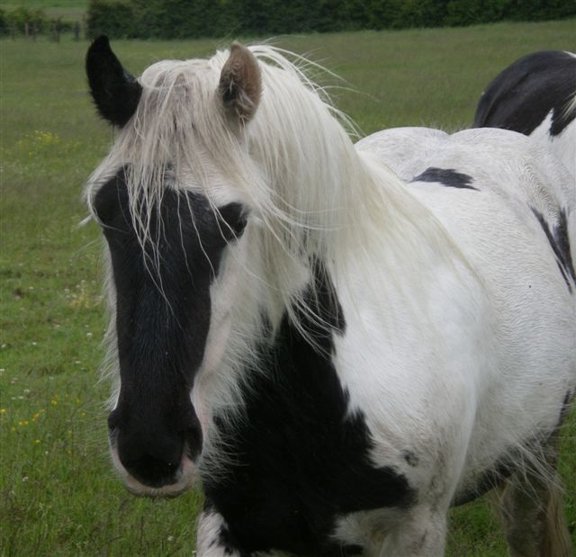
We’ve all noticed a horse’s chrome; whether in common leg white or a tobiano pattern. And as breeders we’ve all given some thought to the mechanics of the stuff, and producing the desired amount of it in our next foal batch.
Even horses with the same genotype will vary with amounts of white expressed, yet there is one factor that influences the white’s expression to a certain degree.
. . . can you guess what it is? That’s okay, neither could I.
The factor is the horse’s base color - the color the horse would be if all dilutions, modifiers, and white patterns were removed. For example, a palomino sabino’s base color is chestnut, and a silver dun’s base color is bay.
It turns out that chestnut-based horses will generally express more white than a bay-based horse. And a bay-based horse will generally express more white than a black-based horse. Horses will also usually have more white on their hind legs than their front legs, and on their near side than their off side.
Interesting? I thought so.
---
Chrome (in horse terminology): White markings
Genotype: Genetic make-up
Near side: A horse's left side
Off side: A horse's right side
Showing posts with label horse genetics. Show all posts
Showing posts with label horse genetics. Show all posts
Friday, March 28, 2014

Saturday, January 4, 2014
Black Chestnut: A Tricky Color
Imagine a black-colored horse galloping through a field lit by the hazy sunset... and the horse had been born illegitimately from chestnut parents. This causes a problem. Chestnut x chestnut ≠ black. Ever. So, what's the deal with this black-colored horse?
---
Black chestnut horses are a tricky bunch to the untaught eye. They can appear black (Aa) over more than 95% of their body, when, in genotype, they are chestnut (Ee). Not to mention, the label "black chestnut" may hint that the horse carries the black allele when the horse either may or may not.
The easiest way to tell if a black-looking horse is chestnut-based is to scan the fetlock color (near each hoof). This is where the base coat of a chestnut will show through.
This is the only picture I have of a black chestnut. The Morgan's name was Joker and he was one of the sweetest geldings around. I don't remember much of him except that he was black-colored with red-tinges near each hoof, and this had me deeply confused.
---
Black chestnut horses are a tricky bunch to the untaught eye. They can appear black (Aa) over more than 95% of their body, when, in genotype, they are chestnut (Ee). Not to mention, the label "black chestnut" may hint that the horse carries the black allele when the horse either may or may not.
The easiest way to tell if a black-looking horse is chestnut-based is to scan the fetlock color (near each hoof). This is where the base coat of a chestnut will show through.
This is the only picture I have of a black chestnut. The Morgan's name was Joker and he was one of the sweetest geldings around. I don't remember much of him except that he was black-colored with red-tinges near each hoof, and this had me deeply confused.
 |
| Black chestnut Morgan gelding. Picture taken by my older bro. |
Now that you understand what a black chestnut horse looks like, let's move on to the two alleles to blame for black chestnut horses.
Alleles that darken chestnut to black chestnut:
- Shade
- Sooty
The shade allele controls the lightness or darkness of a horse's coat. There is more to be discovered about it; such as how it works, which locus it resides in, and how it reacts with other alleles. The easiest way to understand the shade allele is to realize its effects: the shade (brightness/darkness/saturation) of every color can vary.
Neither the shade nor the sooty allele have a concrete label (for example, YzYz), but that should soon change with the growing knowledge of color genetics.
The sooty allele works a little differently than shade allele to accomplish a similar effect (darkening): Shade darkens (or lightens) the horse throughout the whole coat, whereas sooty mixes in black hairs with the base color, darkening the coat in certain areas and leaving other areas 83.7885% untouched.
The strength of the sooty effects varies greatly and can go unnoticed when minor enough. At the opposite end of the spectrum, there are so many black hairs mixed in that the horse is practically black. On bay, the least-affected sooty areas include the flank and muzzle. On black, the effects generally unnoticeable. And, on chestnut, the sooty is fairly flat and consistent, with only the fetlock area left unchanged.
Geneticists are reasoning that there are two different sooty alleles, noting that the affects of sooty on Agouti-based horses (bay, black) differ from those on chestnut-based horses.
Neither the shade nor the sooty allele have a concrete label (for example, YzYz), but that should soon change with the growing knowledge of color genetics.
The sooty allele works a little differently than shade allele to accomplish a similar effect (darkening): Shade darkens (or lightens) the horse throughout the whole coat, whereas sooty mixes in black hairs with the base color, darkening the coat in certain areas and leaving other areas 83.7885% untouched.
The strength of the sooty effects varies greatly and can go unnoticed when minor enough. At the opposite end of the spectrum, there are so many black hairs mixed in that the horse is practically black. On bay, the least-affected sooty areas include the flank and muzzle. On black, the effects generally unnoticeable. And, on chestnut, the sooty is fairly flat and consistent, with only the fetlock area left unchanged.
Geneticists are reasoning that there are two different sooty alleles, noting that the affects of sooty on Agouti-based horses (bay, black) differ from those on chestnut-based horses.
Friday, July 5, 2013
A Plug for 'Color Genetics'
Color Genetics is a website for learning basic coat color genetics that may be applied to any species (horse, cat, and so on). It may be found here: http://colorgenetics.info/
I have yet to venture into the non-equine species topics, and hope to do so in the future. Until then I shall satisfy myself with the amazing horse color knowledge. Not only are there articles on varying topics relating to genetics, but also forums to answer questions, and image galleries.
For a mere hint of this CG's awesomeness, here are some pages you can check out.
"White Patterns in Horses" article, very good and informative.
How the people in the forums figured out Angel's dam's color.
Last yet not least, the Equine Gallery page. This is epic.
There's a lot more than that, but you'll have to go check it out for yourself. When I have a genetics question that lacks an answer, this is where I go.
I have yet to venture into the non-equine species topics, and hope to do so in the future. Until then I shall satisfy myself with the amazing horse color knowledge. Not only are there articles on varying topics relating to genetics, but also forums to answer questions, and image galleries.
For a mere hint of this CG's awesomeness, here are some pages you can check out.
"White Patterns in Horses" article, very good and informative.
How the people in the forums figured out Angel's dam's color.
Last yet not least, the Equine Gallery page. This is epic.
There's a lot more than that, but you'll have to go check it out for yourself. When I have a genetics question that lacks an answer, this is where I go.
Wednesday, May 29, 2013
Wild Bay
Wild bay has a similar phenotype to that of a normal bay, and it's allele (symbolized by A+) is found in the Agouti gene.
It is widely believed that the A+ allele is dominant to the other alleles (bay, black, and seal bay) in the Agouti gene. However, this has not been scientifically verified, and there have been reports of wild bay horses being produced by two bays. Another idea theorized by some is that the wild bay allele is part of a completely separate gene, not Agouti.
Regardless, it's pretty easy to pick out a wild bay from a normal bay. No, they don't all look mean, wild, and nasty. Instead, the black points on the legs only come up to the pastern (horse equivalent of an ankle) instead of the knee.
Here is a picture of a wild bay Arabian, and below that is a picture of a normal bay Mustang. Spot the difference?
 |
| Wild bay Arabian, image by Ealdgyth. |

 |
| Normal bay American Mustang. |
Saturday, January 12, 2013
Unknown Mysteries of Equine Genetics - Silver (Z) and Cream (Cr)
Think we're very far along in knowing all about horse genetics? Nay (or neigh?), we actually aren't. There is so much more to know about genetics and how they function that even after a lifetime of studying, I doubt one would know everything. God definitely has made the equine - along with all other animals - a complex, gorgeous structure of living, feeling, mass. They even can have personalities!
This time I'll be writing some more about the Silver (Z) gene, and a theory pertaining to it and the Cream (Cr) gene. I'm apt to call it simply a hypothesis, but genetic testing would say otherwise. So, it is a theory.
The theory is that the Cream (Cr) gene can carry and inhibit the phenotype of the Silver (Z) gene.
Where did I hear of this? It actually wasn't in Sponenberg's latest book on equine genetics, so it must be a pretty recent thing; or, perhaps, just rarely heard of. Either way, I was browsing through a horse forum and saw this gorgeous buckskin in an icon off to the side. Of course, being me, I had just had to click on this stud's picture:

Taking advantage of the link to the lucky breeding stable that owns this stud, I read some about him and learned that he throws Silver foals! In case you want to read some more about him, or want to view images of him, I'll link you to Willow Bend Farm's page about Golden.
Now get this: Proven from scientific studies, the Silver gene will *always* dilute black on a horse that is Z-positive. Which, as you can tell, creates a problem, as Gold has very, very black points.
Something that I found interesting, though, was that up until he was about three or four years of age, his mane had silver in it. And as a six-week old foal, he appeared to be a chestnut! I'm not sure if this is normal or not for buckskins, but if you're curious- just check out that link. :)
If this hypothesis is proven, we shall know a bit more about horse genetics. However, Silver will still show on most Cream-based dilutes. Here are two silver buckskins for ya.

 And, that'll be all folks! I'd love to receive some feedback on this, whether it be comments, suggestions for blog posts, or questions, so think it over. :)
This time I'll be writing some more about the Silver (Z) gene, and a theory pertaining to it and the Cream (Cr) gene. I'm apt to call it simply a hypothesis, but genetic testing would say otherwise. So, it is a theory.
The theory is that the Cream (Cr) gene can carry and inhibit the phenotype of the Silver (Z) gene.
Where did I hear of this? It actually wasn't in Sponenberg's latest book on equine genetics, so it must be a pretty recent thing; or, perhaps, just rarely heard of. Either way, I was browsing through a horse forum and saw this gorgeous buckskin in an icon off to the side. Of course, being me, I had just had to click on this stud's picture:

Taking advantage of the link to the lucky breeding stable that owns this stud, I read some about him and learned that he throws Silver foals! In case you want to read some more about him, or want to view images of him, I'll link you to Willow Bend Farm's page about Golden.
Now get this: Proven from scientific studies, the Silver gene will *always* dilute black on a horse that is Z-positive. Which, as you can tell, creates a problem, as Gold has very, very black points.
Something that I found interesting, though, was that up until he was about three or four years of age, his mane had silver in it. And as a six-week old foal, he appeared to be a chestnut! I'm not sure if this is normal or not for buckskins, but if you're curious- just check out that link. :)
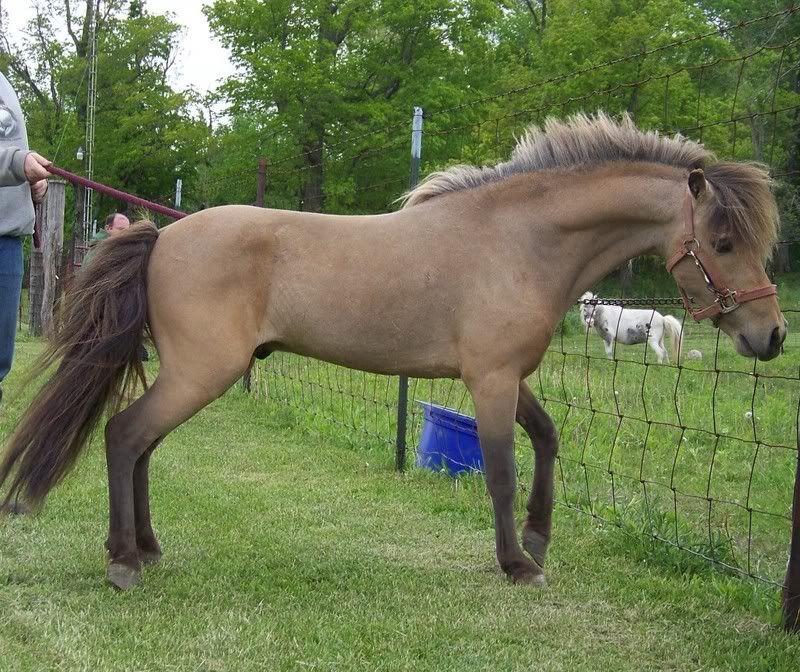
If this hypothesis is proven, we shall know a bit more about horse genetics. However, Silver will still show on most Cream-based dilutes. Here are two silver buckskins for ya.

Tuesday, January 1, 2013
Genetic Alleles
Many times you may hear the word "allele", but not really know what it means. Fortunately, it's actually fairly easy to understand.
An allele is one of two (or sometimes more) variants of a gene, causing different traits to occur.
When there are only two possible allele options in a gene (or locus- a group of genes), it's generally easiest to think of the gene as a switch. If the switch is "off", the trait-producing allele is nonactive, and replaced by the non-trait producing allele. If the switch is "on", the trait-producing allele is either dominating or in homozygous form (sometimes both).
Sometimes there are more than two options for alleles at a specific gene, though. At this point, it's easiest to think of it as a three-(or more)-way switch.
Alleles are either homozygous or heterozygous, and recessive or dominant.
First of all, the normal-sized letters are the shorthand abbreviations for the name of the gene. The superscript ones are the abbreviations of the alleles. Now, note how the first letter of some of the alleles are capitalized, and some aren't?
If the first letter of the allele is capitalized, the allele is dominant. If the first letter is in small caps, the allele is recessive.
And, it's that easy. ;) Ask if you have any questions!
An allele is one of two (or sometimes more) variants of a gene, causing different traits to occur.
When there are only two possible allele options in a gene (or locus- a group of genes), it's generally easiest to think of the gene as a switch. If the switch is "off", the trait-producing allele is nonactive, and replaced by the non-trait producing allele. If the switch is "on", the trait-producing allele is either dominating or in homozygous form (sometimes both).
Sometimes there are more than two options for alleles at a specific gene, though. At this point, it's easiest to think of it as a three-(or more)-way switch.
Alleles are either homozygous or heterozygous, and recessive or dominant.
- Homozygous: The horse has two copies of this allele, and will always pass on one of the copies to its offspring.
- Heterozygous: The horse has one copy of the allele, and will pass on the allele to its offspring about 50% of the time. Sometimes you won't be able to tell by looking at the horse if he is heterozygous for a recessive allele.
- Recessive: A recessive allele is one that the horse must be homozygous for in order for the trait to show in the coat color (or phenotype). If a horse only has one copy of a recessive allele, it will not show in the phenotype.
- Dominant: Dominant alleles are really great, because if a horse has just one copy of them, you'll be able to tell. However, dominant alleles can sometimes mask a recessive allele.
- An example of this would be a Bay horse carrying one copy of the Extension allele. Because the Extension (e) allele is recessive, the dominant Bay (A-) allele would take control, and the horse would be bay.
Also, there's one awesome way to tell if an allele is dominant or recessive in genetic shorthand. As an example, genetic shorthand for a Linebacked Palomino would look like this:
EeEe/CCr/DnDn
First of all, the normal-sized letters are the shorthand abbreviations for the name of the gene. The superscript ones are the abbreviations of the alleles. Now, note how the first letter of some of the alleles are capitalized, and some aren't?
If the first letter of the allele is capitalized, the allele is dominant. If the first letter is in small caps, the allele is recessive.
And, it's that easy. ;) Ask if you have any questions!
Friday, December 14, 2012
An Online, Interactive, Horse Color Genetics Game
Whilst browsing around on Tuesday evening, I found a very well put-together game. More than that, though, it was a horse color genetics game. And interactive. :D
Here is the link: http://www.jenniferhoffman.net/horse/horse-color-genetics.html Kudos to Jennifer Hoffman for making this wonderful tool!
If you start from the actual webpage (I just linked you to the game itself), a guided tour will explain colors and alleles as you go along.
The thing I didn't like about the guided game was that it didn't record previous changes to the horse's color. For example, I had the horse as a seal bay, I proceeded to the next color gene, and the horse changed to a bay, chestnut, black, or otherwise. What?
For that reason I skipped to the end, where I could change any and all alleles, and all at the same time.
It seems people really, really, like this game. One of the comments complained that the game allows you to make impossible colors (such as being homozygous white, which produces a foal that dies in embryo). However, that has been fixed. Now, if you'll try it, you'll be able to have one copy of the white gene, but with both of the copies, the horse vanishes and the text says "Embryonic Lethal". The game also is accurate so far as the four linked or almost-linked KIT alleles.
Another accurate feature - it shows the gray (G) gene as dominant. You can have a multitude of colors underneath, but if a horse has the gray gene in it's phenotype, this will cover everything except white (or pinto) markings.
Interested in horse color genetics? Read more articles here!
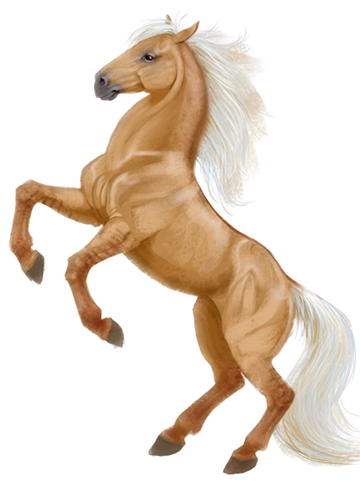
Here's a replica of the stable's AQHA stud, Billy. :)

Here is the link: http://www.jenniferhoffman.net/horse/horse-color-genetics.html Kudos to Jennifer Hoffman for making this wonderful tool!
If you start from the actual webpage (I just linked you to the game itself), a guided tour will explain colors and alleles as you go along.
The thing I didn't like about the guided game was that it didn't record previous changes to the horse's color. For example, I had the horse as a seal bay, I proceeded to the next color gene, and the horse changed to a bay, chestnut, black, or otherwise. What?
For that reason I skipped to the end, where I could change any and all alleles, and all at the same time.
It seems people really, really, like this game. One of the comments complained that the game allows you to make impossible colors (such as being homozygous white, which produces a foal that dies in embryo). However, that has been fixed. Now, if you'll try it, you'll be able to have one copy of the white gene, but with both of the copies, the horse vanishes and the text says "Embryonic Lethal". The game also is accurate so far as the four linked or almost-linked KIT alleles.
Another accurate feature - it shows the gray (G) gene as dominant. You can have a multitude of colors underneath, but if a horse has the gray gene in it's phenotype, this will cover everything except white (or pinto) markings.
Interested in horse color genetics? Read more articles here!
Here's a replica of the stable's AQHA stud, Billy. :)
Monday, December 10, 2012
The Silver (Dapple) Gene
Just recently, I've dived (just a short dive though) back into horse genetics, colors, and research. This time, however, I have a specific area that I'm gaining knowledge on- the Silver (ZZ gene).
It really is an interesting gene. Similar to the Cream and Champagne genes, it is a dilution gene. However, it goes a smidgen more complex than just that- the ZZ allele will only affect eumelanin; that is, black hair color. The only other melanin in horses is pheomelanin (the red/brown/yellow coloring), and that is left unaffected.
Before I get to the fun part, there are a few more factors to cover. The ZZ gene is located on horse Chromosome 6, in the PMEL17 gene. It is a simple dominant allele, so if a horse has this trait, it will appear in the phenotype. The one exception to this is if the horse is a chestnut, in which case it'll take either breeding or testing to tell.
EDIT: The gene may not be a simple dominant allele. Please read my later blog post on it!
By breeding, let me use this example to explain what I mean: If you breed your chestnut mare to a black stud, and produce a silver bay, you then know that your mare carries silver-positive allele.
Sure, one may think that breeding to find out true color (which one cannot always find through this method) saves you...say, $40 by not testing. However, if color is an element of your breeding program, and you can scrap together 40 bucks, do it. It isn't that hard- just follow the instructions here.
Okay, yay! Time for the fun stuff. :) Let's start with a few base colors + silver gene = the answer.
Black + ZZ = Chocolate (or Blue) Silver
Bay + ZZ = Bay Silver
Chestnut + ZZ = Chestnut (but carries the Silver allele)
And of course, there are combinations of base color + Silver + other dilution or extension genes. However, I'll save that for another time.
Do you remember the Miniature mare that foaled out this June? She's actually a silver, as she has all the characteristics that the Silver allele elicits, and her sire had the allele. I'm almost certain that she's a seal bay silver, but nothing's been verified.
If you don't want to go digging through my awesome blog posts to find the picture of Bunny, here she is. And who knows, maybe Dove will be a Silver carrier as well. (:
It really is an interesting gene. Similar to the Cream and Champagne genes, it is a dilution gene. However, it goes a smidgen more complex than just that- the ZZ allele will only affect eumelanin; that is, black hair color. The only other melanin in horses is pheomelanin (the red/brown/yellow coloring), and that is left unaffected.
Before I get to the fun part, there are a few more factors to cover. The ZZ gene is located on horse Chromosome 6, in the PMEL17 gene. It is a simple dominant allele, so if a horse has this trait, it will appear in the phenotype. The one exception to this is if the horse is a chestnut, in which case it'll take either breeding or testing to tell.
EDIT: The gene may not be a simple dominant allele. Please read my later blog post on it!
By breeding, let me use this example to explain what I mean: If you breed your chestnut mare to a black stud, and produce a silver bay, you then know that your mare carries silver-positive allele.
Sure, one may think that breeding to find out true color (which one cannot always find through this method) saves you...say, $40 by not testing. However, if color is an element of your breeding program, and you can scrap together 40 bucks, do it. It isn't that hard- just follow the instructions here.
Okay, yay! Time for the fun stuff. :) Let's start with a few base colors + silver gene = the answer.
Black + ZZ = Chocolate (or Blue) Silver
Bay + ZZ = Bay Silver
Chestnut + ZZ = Chestnut (but carries the Silver allele)
And of course, there are combinations of base color + Silver + other dilution or extension genes. However, I'll save that for another time.
Do you remember the Miniature mare that foaled out this June? She's actually a silver, as she has all the characteristics that the Silver allele elicits, and her sire had the allele. I'm almost certain that she's a seal bay silver, but nothing's been verified.
If you don't want to go digging through my awesome blog posts to find the picture of Bunny, here she is. And who knows, maybe Dove will be a Silver carrier as well. (:
 |
| Bunny, a Silver Dapple mare |
Wednesday, November 28, 2012
Confirmed Hypothesis
Just the other day, I got a chance to talk to a lady who attended college solely for learning about horse genetics. A couple points she made were foreign to me, but I'll take her word for it for unless I hear otherwise from a reputable source.
First of all, I learned that approximately half the population of horses have a roan gene, but it doesn't always appear if it isn't prominent enough (so it isn't a dominant gene, it's recessive). Which explains how one of my friends got a chestnut roan from two solid chestnuts.
Also concerning roan, it is possible to get the roan gene from the sabino gene. So now Cayenne's coloring is possible, yay!
I asked her one more question- how do you get a bay from a palomino and a chestnut? Okay, this is the one piece of information that seems iffy-ish to me, so I'll have to look into it further. Either way, she said that palomino's can indeed be a black base color, but you cannot see it because of the palomino dilution.
EDIT: Now, I would disagree. One copy of a cream gene on black does not produce a palomino-colored horse. Turns out that the "chestnut" is actually a silver bay.
So, that's that. If I remember what I had wanted to write about, or find that list of topics to write about, I'll try to do another blog post soon. :) And one that's a bit more interesting.
First of all, I learned that approximately half the population of horses have a roan gene, but it doesn't always appear if it isn't prominent enough (so it isn't a dominant gene, it's recessive). Which explains how one of my friends got a chestnut roan from two solid chestnuts.
Also concerning roan, it is possible to get the roan gene from the sabino gene. So now Cayenne's coloring is possible, yay!
I asked her one more question- how do you get a bay from a palomino and a chestnut? Okay, this is the one piece of information that seems iffy-ish to me, so I'll have to look into it further. Either way, she said that palomino's can indeed be a black base color, but you cannot see it because of the palomino dilution.
EDIT: Now, I would disagree. One copy of a cream gene on black does not produce a palomino-colored horse. Turns out that the "chestnut" is actually a silver bay.
So, that's that. If I remember what I had wanted to write about, or find that list of topics to write about, I'll try to do another blog post soon. :) And one that's a bit more interesting.
Saturday, October 13, 2012
Understanding a Horse's Base Color
To understand horse color in general, you first must understand the three base colors and how they work. However, I won't touch much on the latter bit, as that is very complex and I don't want to confuse you (or myself, for that matter). So, to learn how each base color came to be, I'd suggest reading what D. P. Sponenberg's "Equine Color Genetics" has to say about it.
Anyway, to get back to the point; there are three base horse colors. There isn't any certain order, but I chose to arrange them as bay, chestnut, and black - as that is generally the order in how common each color is. Of course in some breeds, such as the Friesian and Suffolk Punch, they have been bred selectively for so long that it is rather difficult to get a chestnut Friesian, or a black Suffolk. And at least for the latter breed, if the horse is any color other than chestnut, it can't be registered anyway.
I imagine you all know what a bay, chestnut, and black horse looks like. Just in case you don't, here's a short description of each.
- Bay - A body color ranging from medium-dark brown, and oftentimes having a reddish tint to it. The points (tips of ears, mane, tail, and lower legs) are black. Sometimes a bay horse can have countershading and some people may think their horse is just a darker colored dun. Thankfully, there are more characteristics to a horse with a dun gene than just a dorsal stripe. There are also some subtypes to bay, and those are listed below.
- Sooty Bay - The sooty effect on any color simply means that the horse has a slightly darker body, with a few areas (head, flank) being the color underneath.
- Wild Bay - If you've ever seen pictures of a Przewalski's horse, then you probably have an idea what a wild bay is. A wild bay can be quite lighter than a normal bay horse, and the black on the legs doesn't always start till about the pastern, and even then it isn't always that black.
- Chestnut - This is simply a yellow-to-red-to-brown colored horse. They can have flaxen mane and tail as well, but that doesn't have anything to do with the genotype as far as we know.
- Liver chestnut - A liver chestnut may sometimes be confused for a bay, but in reality the genotype is exactly the same as a chestnut. The phenotype, however, is a lot darker. Liver chestnuts can still have flaxen mane and tail.
- Sorrel - In reality, sorrels are the same as chestnuts, but some people (and breed associations) just prefer to use different words. To get around this inconvenient issue, some horse geneticists will just use the term "red".
- Black - This is a completely black horse. When identifying a black horse though- one must be careful. Generally the easiest way to tell if a horse is really black is to search for the absence of red hairs near the eyes, flank, and pasterns. However, one also must keep in mind that some black horses will bleach out in summer (known as a summer black) while others will not (known as jet black).


Anyway, below are some charts to help you understand three common color genes in conjunction with the three base colors. The top layer is the base color, the second is the gene, and the third is the resulting phenotype. Also, for the champagne resulting colors it is not just a single word, but the word and then "champagne". For example, a gold champagne would be called a gold champagne, but not a "gold".


P.S. - If a horse has two copies of the cream gene, the affects will be different. Two copies of the cream gene on a bay or black results in a perlino, and two copies of the cream gene on a chestnut results in the lighter colored cremello.
Friday, October 5, 2012
A Bit on Horse Color Genetics
So! I realize that this blog is pretty much abandoned, but I figured I may as well write a blog post. First of all, the book Equine Color Genetics by Dan Sponenberg is an *amazing* book. Yes, it is complex (as always will be with genetics of any type), but within the first 15 pages (and skimming through the tons of colored pictures and charts and appendixes) I have learned a lot. So, if you have any interest in learning about horse color genetics, or even just want to figure out the color of your horse, I highly, highly suggest reading it. However, as it is a bit pricey (even from Amazon), I'd suggest checking it out from your local library, as I did.
DISCLAIMER: Yes, even though disclaimers are pesky little bots, I just wanted to say that I have researched/learned about this topic for less than a total of 12 hours, and as it is very complex I could have things wrong. If I mess up on something, can you please make note of it and tell me?
Hmm...I suppose I shall just place a random collection of horsey genetic stuff and information-similar-to-that at this specific locus (aka location). Here goes! :D
- Horse color genetics work fairly simple- each horse has a pair of a specific genes, and when it reproduces with another horse, the foal receives a *random half of a gene from each specific locus from the dam, and same from the sire.
- *Random = not always quite so random when one of the parents is homozygous for a specific gene.
- If you removed all top layers of pigment from the horse, it would not be white. Some people think of a horse as a white canvas with the color on top of that. That is not true. The horse has a base coat of either black or *red, then the other colors are either extensions or dilutes. On top of all that is white patches (either markings or a pinto/Appy pattern).
- *Red (by horse geneticists) is used for either chestnut or sorrel. Saying one of the latter may get you going with a horse breeder about the definition of chestnut vs. the definition of sorrel (when genetically they're the same). And it gets even worse when certain breed regulations call some horses a chestnut if they are of a darker coat with silver-toned mane and tail, whereas they call a sorrel a yellow or gold-toned horse. And then some breeds only use the term chestnut (such as with Arabians) whereas some only use the word sorrel (as with Quarter Horses, I'm pretty sure). So instead, just use red. ;)
- There are basically 14 layers of horse colors. It starts with a base coat of either red (ee) or black (Ee or EE). After that comes the layer that, if the base coat is black, defines the amount of black. For this second layer, AA or Aa limits the black to a horse's points, whereas aa doesn't restrict the black at all, and the horse will just be black. After that comes the cream gene, the dun gene, the champagne gene, and so forth. For a complete list of abbreviations of alleles, the 14 genes, and their affect on a horse, see Wikipedia's article on this.
- Did you know that there is an actual Mushroom horse color gene? Apparently this is a newly discovered dilution gene, and looks quite makes an affect quite similar to the Silver gene. This is gene is still hardly understood, and a main fact of that is probably that most people confuse their Mushroom horses for Silver horses. Whereas, if they DNA tested their horses the owners' would find that their horse came up negative for the Silver gene.
- Also, there are some pretty rockin' awesome horse color modifiers out there! :D This webpage is pretty information-filled (and picture-filled) and if you love horses, you'll love this.
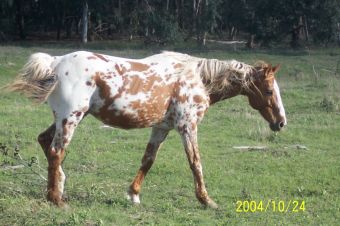 |
| A manchado horse |
 |
| I was going to be chestnut, but decided to change to black last minute. |
 |
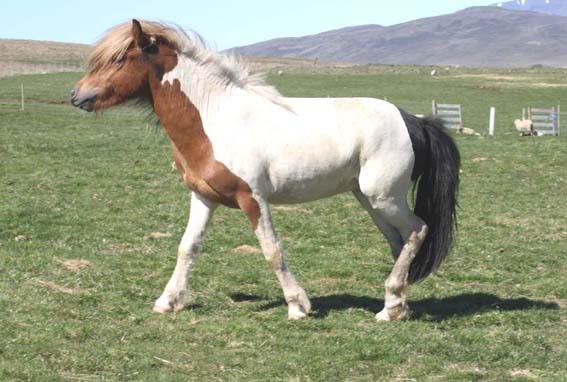
| A pretty little tovero |
Subscribe to:
Posts (Atom)